Designing Fatigue-Aware VR Interfaces via Biomechanical Models
The paper "Designing Fatigue-Aware VR Interfaces via Biomechanical Models" by Harshitha Voleti and Charalambos Poullis will appear in the ACM SIGCHI Symposium on Engineering Interactive Computing Systems (EICS), 2026.
TL;DR: Mid-air interaction in VR is tiring, and getting ergonomic UI layouts right today means running expensive human-in-the-loop studies. The paper introduces a hierarchical reinforcement-learning framework where a biomechanical simulated user "feels" fatigue through a validated muscle model, and that simulated fatigue trains a UI agent to place interface elements in layouts that real humans then report as significantly less tiring.
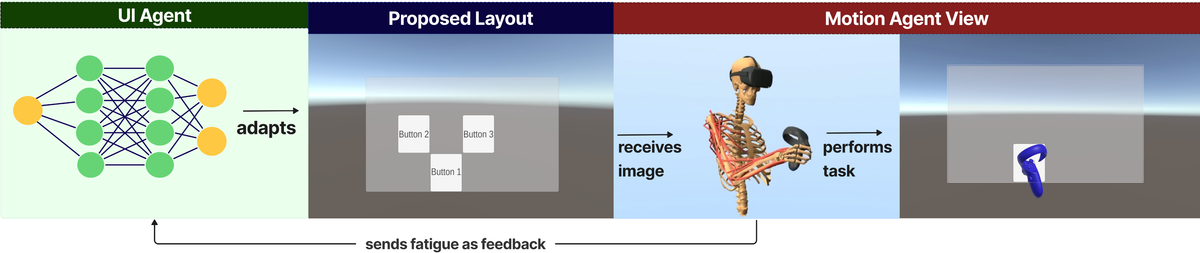
The framework has two agents working in a closed loop. A low-level motion agent, built on a muscle-actuated biomechanical model, learns to perform sequential button-press tasks in VR using realistic movement, while a three-compartment control with recovery (3CC-r) model estimates muscle-level effort. A high-level UI agent then selects discrete grid positions for the interface elements, with the aggregated simulated fatigue serving as a reward signal — no labeled human data and no hand-crafted ergonomic heuristics required. The RL-optimized layout is compared against a manually-designed centered baseline and a Bayesian-optimized baseline, both in simulation and in a human study where participants reported subjective effort via the Borg CR10 scale and workload via NASA-TLX. Fatigue trends predicted by the biomechanical model align with those observed in real users, and the RL-optimized layout produced significantly lower perceived fatigue than the baselines in the follow-up human study. The paper also demonstrates extensibility through a simulated case study on longer sequential tasks with non-uniform interaction frequencies. To the authors' knowledge, this is the first work to use simulated biomechanical muscle fatigue as a direct optimization signal for VR UI layout design, pointing toward a path where designers can pose "what if?" ergonomic questions in silico long before booking a user study.
Research paper: https://arxiv.org/abs/2603.26031